What’s Really in Your Tap Water — And Why Your Current Filter Isn’t Enough
Section 1: Why “Clear” Water Isn’t Enough Anymore
If you’re reading this, you’re probably shopping for a home water filter — and already feeling overwhelmed. Pitcher filters, under-sink systems, Reverse Osmosis units. The options seem endless, and the marketing language even more so.
But here’s what changed my perspective entirely: becoming a father.
When my wife Esther and I fill our two-and-a-half-year-old son Zachariah’s cup, we’re not just thinking about hydration. We’re thinking about what we can’t see. And once you understand what modern tap water actually carries, you can’t unsee it.
For decades, the benchmark for safe water was simple: does it look clear? Does it taste okay? That standard made sense for the 20th century. It doesn’t anymore.
Today’s threats are invisible. They don’t affect the colour, smell, or taste of your water. They accumulate quietly in your body over years. And most standard water filters — including some expensive ones — were never designed to stop them.
This guide will walk you through exactly what’s hiding in modern tap water, what technology actually removes it, and how to choose a system that protects your family without wasting water, money, or your time.
Section 2: What’s Actually Hiding in Your Glass
Water treatment facilities do a genuinely good job at the source. The real problem is the journey water takes after leaving the plant.
By the time treated water travels through kilometres of ageing underground pipes to reach your kitchen tap, it has picked up passengers the facility never intended to send. Micro-cracks in old infrastructure allow groundwater, soil runoff, and agricultural chemicals to seep in along the way.
If you’re relying on a basic pitcher filter, a tap attachment, or even an older Reverse Osmosis system, your family may be exposed to three categories of contaminants that most people have never heard of.
1. Microplastics
Researchers estimate the average person consumes roughly a credit card’s worth of plastic every week. It enters the water cycle when synthetic clothing is washed, when plastic waste degrades outdoors, and when industrial runoff reaches rivers and reservoirs. These particles are often smaller than 5 microns — far too small for standard municipal filtration to catch.
A basic carbon pitcher filter has pores that are simply too large. Stopping microplastics requires filtration down to 0.2 microns, which is 300 to 500 times smaller than a single strand of human hair.
2. PFAS — “Forever Chemicals”
PFAS (per- and polyfluoroalkyl substances) are found in non-stick cookware, water-resistant clothing, and stain-repellent sprays. They’re called “forever chemicals” because they don’t break down — not in nature, and not inside the human body. Long-term exposure is increasingly linked by health authorities to hormonal disruption and compromised immune function.
One important myth to address here: boiling your water does not remove PFAS. It does the opposite. As water boils, pure water escapes as steam, which means the chemicals left behind actually become more concentrated. To remove forever chemicals, you need a dense, high-quality activated carbon block that physically adsorbs them as water passes through.
3. Pharmaceutical Residues
This one surprises most people. Trace amounts of human medications — antibiotics, painkillers, hormonal drugs — enter the water cycle through human waste and improper disposal. Conventional water treatment plants were not designed to filter these out, and most aren’t yet equipped to do so.
Many households upgrade to Reverse Osmosis systems to tackle contaminants like these, and RO does work — but it works too well. It strips everything from the water, including the calcium and magnesium your body actually needs. The result is demineralised, slightly acidic “dead water.” RO systems also waste up to three litres of water for every one litre they produce, which is an expensive and environmentally costly trade-off.
When Esther and I were researching options for our family, we kept running into the same problem: we wanted thorough protection without sacrificing the minerals essential for a growing child’s development, and without a system that guzzled water down the drain.
Section 3: The Filter That Knows What to Keep
Your Water A side-by-side breakdown of modern water threats, filtration technologies, and the real cost of protecting your family.
| Contaminant | Health Risk | Boiling | Pitcher Filter | Reverse Osmosis | eSpring Pro |
|---|---|---|---|---|---|
| MicroplasticsParticles under 5 microns from synthetic materials | High | ||||
| PFAS / Forever ChemicalsIndustrial chemicals linked to hormonal disruption | High | ||||
| Pharmaceutical ResiduesTrace medications from human waste & runoff | Medium | ||||
| Bacteria & VirusesBiological pathogens causing waterborne illness | High | ||||
| Chlorine & Taste/OdourAdded during municipal treatment | Low | ||||
| Lead & Heavy MetalsLeached from ageing pipes and infrastructure | High | ||||
| Beneficial MineralsCalcium & Magnesium — essential for health | Keep |
| Expense | Pitcher Filter | Reverse Osmosis | eSpring Pro |
|---|---|---|---|
| Initial purchase | RM 150 | RM 1,500 – 3,000 | RM 4,680 |
| Annual filter / maintenance | RM 200 – 400 / yr | RM 300 – 600 / yr | RM 595 / yr |
| UV lamp replacement | — | RM 150 – 300 / yr | None (10-yr LED) |
| Technician service calls | — | RM 100 – 200 / yr | None |
| Water wasted | Minimal | 3L wasted per 1L clean | Zero waste |
| Estimated 10-Year Total | RM 2,150 – 4,150 | RM 6,000 – 9,000 | RM 10,035 |
| Cost per day | RM 0.59 – 1.14 | RM 1.64 – 2.47 | RM 2.75 |
| Feature | Specification | What It Means for You |
|---|---|---|
| Filtration Depth | 0.2 microns | Stops microplastics, asbestos fibres, and fine sediment |
| Contaminants Removed | 170+ certified | Covers PFAS, pesticides, pharmaceuticals, heavy metals |
| UV Technology | UV-C LED Mercury-free | Instant-on sterilisation; no warm-up delay |
| Pathogen Removal | 99.9999% bacteria 99.99% viruses | Exceeds NSF/ANSI Standard 55 certification |
| UV LED Lifespan | Up to 10 years | No lamp replacements throughout your child’s childhood |
| Filter Change Cycle | 1× per year 5,000 L | 2-minute swap, no tools, no technician needed |
| Minerals Preserved | Calcium Magnesium | Water stays biologically “alive” — not stripped like RO |
| Water Waste | Zero | Unlike RO, every litre in becomes a litre out |
| Smart Monitoring | RFID + App | Real-time filter life, pressure alerts, usage tracking |
| Energy Efficiency | 25% less energy | Lower running costs vs. older UV models |
So boiling concentrates chemicals. Basic pitchers miss microplastics. RO strips the water of everything beneficial. What’s the actual answer?
The solution we found is built around what I’d call an intelligent filtration philosophy — one that removes what harms you while deliberately preserving what your body needs.
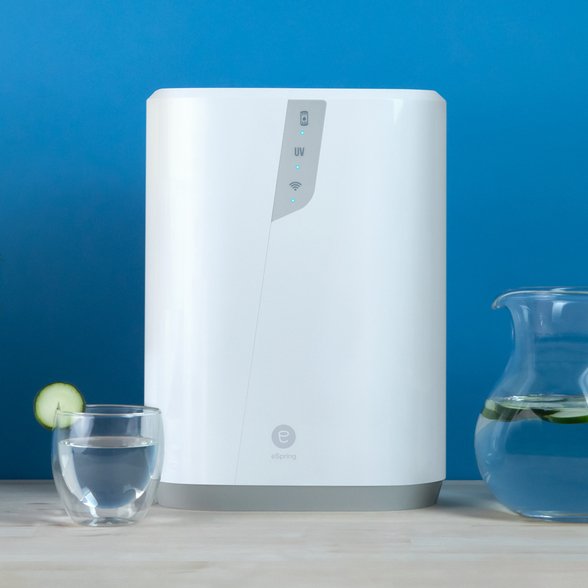
The Amway eSpring Pro achieves this through its e3 Carbon Filter, which works in three stages.
Stage 1 — The Pre-Filter The first layer intercepts the visible debris picked up from ageing pipes: rust, sediment, and particulate matter. This protects the inner layers from clogging and extends the system’s overall life.
Stage 2 — The Defence Guard (0.2 Micron Barrier) This is where microplastics, asbestos fibres, and similarly sized particles are stopped. The Defence Guard is engineered to trap particles down to 0.2 microns — the threshold needed to address the microplastic problem that most filters simply ignore.
Stage 3 — The Pressed Carbon Block Made from coconut-shell activated carbon compressed into a dense block, this stage forces water through a microscopic maze where the carbon acts as a powerful chemical sponge. It draws out over 170 contaminants — including PFAS, pesticides, herbicides, and pharmaceutical residues.
Here’s the critical distinction: while the carbon block captures toxins, it is specifically designed to allow beneficial minerals like calcium and magnesium to pass through untouched.
The water that reaches your glass isn’t stripped and flat. It’s mineral-rich, clean, and noticeably better tasting — what I’d describe as water that’s actually alive.
Section 4: The End of Boiling — UV-C LED Technology
Chemical and physical contaminants are one category of threat. Biological ones are another.
Waterborne bacteria and viruses are the reason “boil water advisories” still get issued in modern cities. Boiling works, but it’s slow, heats your kitchen, and is simply unsustainable as a daily routine for a busy household.
Older premium UV purifiers offered an alternative, but came with a significant drawback: mercury-vapor lamps. These required annual replacement, took seconds to warm up, and introduced a toxic material into the home. Not an acceptable trade-off in 2026.
The Amway eSpring Pro replaces mercury-vapor technology entirely with UV-C LEDs — the same category shift as moving from incandescent bulbs to modern LEDs, applied to water purification.
The practical difference is significant. The moment you turn on the tap, the UV-C LEDs activate instantly — no warm-up, no delay. As water flows past them, the light disrupts the DNA of pathogens at a cellular level, neutralising 99.9999% of bacteria and 99.99% of viruses. This performance is certified under NSF/ANSI Standard 55, one of the most rigorous independent standards for UV water purification.
What makes this genuinely remarkable for a family is the lifespan: these LEDs are built to last up to 10 years. No bulb changes. No toxic materials to dispose of. No annual service calls.
When I think about the next decade — watching Zachariah grow from a toddler into a teenager — I find real comfort knowing that the same UV system will be quietly protecting every glass of water, every piece of fruit washed, every pot of soup cooked throughout his entire childhood. The system also uses 25% less energy than older UV models and produces zero water waste.
Section 5: Smart Maintenance That Works Around Your Life
Even the most advanced water filter becomes a liability if it’s difficult to maintain. A filter that’s overdue for a change isn’t just ineffective — it’s potentially worse than no filter at all, because it gives you false confidence.
Most households manage filter changes by guessing. They wait until the water tastes different, or until flow pressure drops noticeably. Others are locked into service contracts that require scheduling technician visits — adding logistical friction, cost, and the lingering doubt of whether the change happened at the right time.
The eSpring Pro connects directly to the Amway Healthy Home App on your smartphone. Using RFID technology built into the filter cartridge, the app gives you a real-time readout of filter life remaining, total litres filtered, water pressure status, and alerts when a replacement is actually due — not when a calendar says it might be.
Esther runs a demanding manufacturing business. I run my own. Between work and keeping up with a two-year-old, neither of us has bandwidth to micromanage an appliance. The app removes that entirely.
And when the time comes to replace the cartridge, Amway engineered what they call the 2-1-0 Promise:
- 2 minutes to complete the swap
- 1 time per year (or every 5,000 litres)
- 0 tools required
You twist the top off, pull the old cartridge out, drop the new one in, and close it. No turning off the main water supply. No technician. Anyone in the household can do it.
Section 6: What It Actually Costs — And What It’s Worth
When the conversation turns to price, most people expect a system this capable to be prohibitively expensive. The numbers tell a different story.
Consider what a typical Malaysian family of four already spends on technology. A reasonable smartphone costs around RM 2,500. Four phones means RM 10,000, replaced roughly every five years as devices slow down, break, or become obsolete. Add mobile data plans at approximately RM 50 per person per month, and you’re spending RM 2,400 annually just to stay connected.
We pay these costs without much deliberation because we value what the technology gives us.
Now look at the eSpring Pro over a full decade:
| Cost | |
|---|---|
| Initial unit (Year 1) | RM 4,680 |
| Cartridge replacements (Years 2–10, RM 595 × 9) | RM 5,355 |
| Total over 10 years | RM 10,035 |
That 10-year total is roughly equivalent to one round of smartphones for a family of four — except the phones may last five years, while the eSpring Pro protects your family for ten.
Broken down further, that’s RM 2.75 per day for unlimited, biologically safe, mineral-rich water for your entire household. Less than a cup of tea at a hawker stall. Less than almost anything else you’ll spend money on today.
A Final Word
Water is the foundation everything else is built on. You use it to brew your morning coffee, wash your vegetables, cook your family’s meals, and hydrate your children. It’s the one thing in your home that touches everything.
Upgrading to the eSpring Pro was one of the clearest decisions Esther and I made for our family. Not because of the technology — though it’s genuinely impressive — but because of what it gave us back: certainty. Every time I fill Zachariah’s cup, I don’t wonder what’s in it.
We spend thousands staying connected to the world. For RM 2.75 a day, you can stay connected to something that matters even more.
If you’re ready to stop guessing about your water quality and bring real, certified protection into your home, I’m here to help you make it happen.